
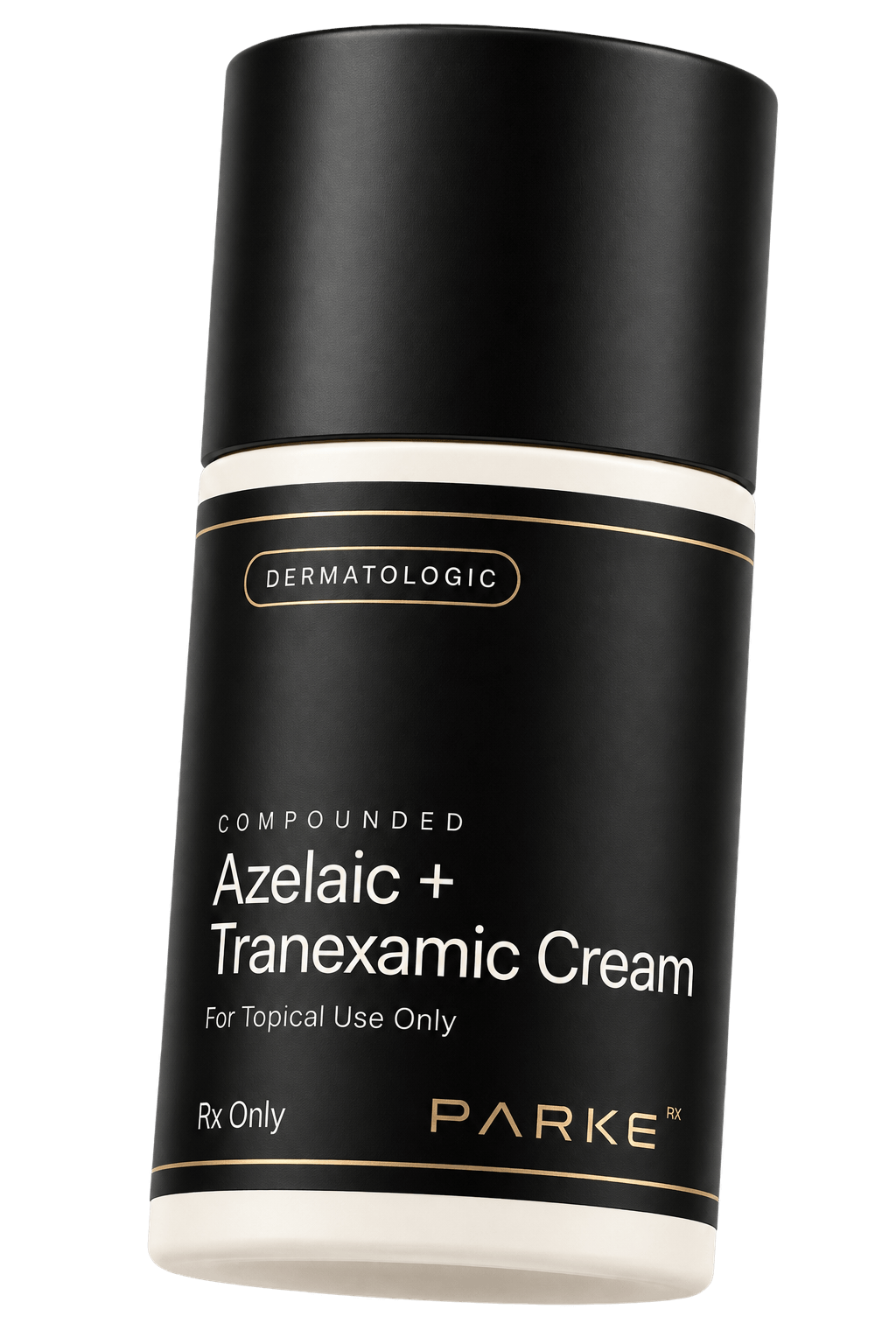


Rendering shown. Your prescription arrives in Parke's unmarked packaging. Compounded medications are not FDA-approved.
Azelaic + Tranexamic RX
One cream for uneven tone and dark spots, built from three named actives: azelaic acid, tranexamic acid, and niacinamide. Those two jobs are the whole promise, pursued patiently, with a clinician who screens you first.
Azelaic + Tranexamic is a compounded medication, prepared for your prescription by a state-licensed US 503A compounding pharmacy. Compounded medications are not FDA-approved.
- 30 g of cream, a full 30-day supply, applied morning and night
- Three actives, each a component of prescription medicine
- Free discreet delivery, every month
- Unlimited clinician messaging between refills
Your final plan and price are set with your clinician, and you can pause or cancel anytime.
Three actives.
One steady job.
Azelaic + Tranexamic is a twice-daily cream prescribed for uneven tone and dark spots. Here is what is in it, described plainly.
The workhorse
A dicarboxylic acid that occurs in nature and has been a prescription topical in US dermatology for decades, with uneven tone among the reasons clinicians reach for it.
The pigment specialist
A lysine-derived compound best known as an oral prescription medicine, studied by dermatology in topical form for dark spots and discoloration.
The supporting vitamin
A form of vitamin B3 and one of the most widely used ingredients in modern skincare. It rounds out the base of the cream.
Tone, and only tone
This cream is prescribed for evening skin tone and fading dark spots. That is the whole claim, on purpose, and it is pursued over months, not mornings.
Even tone, patiently pursued.
Your clinician decides whether it fits you.
Two minutes, twice a day.
A thin layer in the morning, a thin layer at night, and sunscreen holding the line in between.
- A thin layer, morning and night. On clean, dry skin, with guided instructions in your member portal. The 30 g supply is measured to last the month at that rhythm.
- Sunscreen is half the protocol. Sun exposure deepens the dark spots you are working on. Daily SPF protects the progress; without it the cream is rowing upstream.
- A clinician on your side of it. Questions between refills are answered by your care team, usually the same business day.
 Built for real life
A slow tissue, judged fairly.
Pigment sits deep in the skin's renewal cycle and changes over months, not days. The protocol is built around that honesty. Yours may differ.
Learning the habit
A thin layer twice daily on clean, dry skin. Expect a brief tingle in the first days, common with azelaic acid, and usually gone within the first weeks.
Giving pigment time
Dark spots formed over years do not answer in days. Changes in tone tend to arrive gradually across the first months, which is why nobody should judge this in week two. Photos beat memory here.
Only as long as it earns it
At the review you and your clinician decide together, ideally with your own before photos on the table. If you cannot tell the difference after a fair trial, they will say so rather than keep shipping it.
Every refill is reviewed. Refills at Parke are approved by the clinician who knows your chart, never by an auto-renewal system. Adjustments, including pausing or stopping, are included in your plan.
Prescription lineage,
honest limits.
Azelaic acid. Tranexamic acid. Niacinamide. Each is a component of prescription medicine, combined here in one twice-daily cream.
What is well established is the lineage: azelaic acid has been a prescription topical in US dermatology for decades, tranexamic acid is a long-standing prescription medicine whose topical use for discoloration has been studied in dermatology, and niacinamide is among the most familiar ingredients in skincare.
What is not established is this combination as a whole, which has not been studied together in rigorous trials. It is prescribed for uneven tone and dark spots, and Parke markets it for nothing beyond those uses. Change is gradual, individual results vary, some people notice little, and nothing here is guaranteed. What you receive is a compounded preparation, which is not FDA-approved or evaluated.
Tone work, done in the open.
You don't have to choose alone. Your clinician weighs your skin, your history, and your goals, and will tell you plainly if this cream is not the right place to spend your money.
On the cream, in their words.
“Nobody promised me a new face. They told me what the cream was for and to judge it at twelve weeks with photos, not memory. That is exactly how it went.”
“The first week it tingled going on, exactly as they said it would, and then it stopped. I trust a company more when the small print happens on schedule.”
“Morning and night, two minutes each. The sunscreen lecture was the part I needed most, and my clinician knew it before I did.”
Individual results and experiences vary. Testimonials reflect the experiences of specific members and are not a guarantee of outcomes. Treatment is prescribed only when a licensed clinician determines it is appropriate.
Side effects, said plainly.
You deserve the whole picture before you start, not after.
Common, especially at first
- A brief tingle, sting, or burning feeling when the cream goes on
- Dryness, mild peeling, or itch at the application area
- Temporary redness where it is applied
- Most of this arrives in the first weeks and settles as skin adjusts
Stop and message your clinician
- Any new change in skin color where you apply it, in either direction
- Severe burning, blistering, or swelling of the skin
- A rash that spreads beyond the application area
- Hives, facial swelling, or trouble breathing: seek immediate care
How Parke handles this: your clinician screens your full history first, including pregnancy or breastfeeding, any history of blood clots or a clotting disorder, since tranexamic acid earns a careful conversation even in a cream, skin conditions at the application area, and any sensitivity to the components. The cream is for external use only, kept away from the eyes, mouth, and broken skin, daily sunscreen is part of the protocol, and your care team is reachable between refills, usually the same business day. Full details in the important safety information.
Asked, answered, plainly.
Can't find your question? Message us. A human on our care team replies, usually within a few hours.
Three named actives in one 30 g cream: azelaic acid, a prescription topical staple in dermatology; tranexamic acid, a long-standing prescription medicine studied topically for discoloration; and niacinamide, a form of vitamin B3. It is prescribed by a licensed clinician, when appropriate, and prepared for your prescription by a state-licensed US 503A compounding pharmacy.
Two things: evening out skin tone and fading dark spots. You will notice we claim nothing else, and that is deliberate. Discoloration is a narrow job that these ingredients are suited to; anything broader would be marketing, not medicine.
No. Compounded medications are not FDA-approved, and this cream is no exception. All three of its actives are components of medicines that have been through the FDA approval process, and the combination itself is compounded per prescription, which is permitted because it is not a copy of any commercially available drug. The combination has not been through the approval process, and we say that plainly because you should not have to find it in a footnote.
Fair question. Tranexamic acid is best known as an oral prescription used to manage heavy bleeding. Dermatology researchers later took an interest in it for a different reason: applied topically, it has been studied for dark spots and discoloration. What you are getting here is that second, topical life of the molecule, compounded to a prescription, at a fraction of the exposure of the oral form.
Gradual change, if any, over months. Pigment sits deep in the skin's renewal cycle: dark spots that formed over years fade slowly, and day to day you will see nothing move. Take photos before you start; they are the only honest referee. The 12-week review is where you and your clinician decide, with those photos, whether the cream earned its place.
Often, briefly, at first. A tingle or mild sting on application is the most commonly reported effect of azelaic acid, and it usually fades within the first weeks as skin adjusts. If irritation builds instead of settling, or you see any new change in skin color where you apply it, stop and message your clinician.
Eligibility is a clinical decision made from your full intake. The cream is not prescribed with a known sensitivity to azelaic acid, tranexamic acid, niacinamide, or any component, is not applied to broken or actively inflamed skin, and pregnancy, breastfeeding, and any history of blood clots are part of the conversation before anything is written. A new, changing, or irregular dark spot needs a clinician's eyes before any cream, and yours will say so. See the full eligibility page.
Everything: your medication, clinician reviews, unlimited care-team messaging, and free discreet shipping. No membership fees, no hidden charges, no cancellation fees, and you can pause or cancel anytime from your member portal.
Explore other concierge treatments.


Even tone, honestly pursued, starts with a conversation.
A private 2-minute assessment, read by a clinician who will decide with you: this cream, something else, or nothing at all.
No charge unless a clinician approves your plan · Pause or cancel anytime
Important safety information: compounded azelaic acid + tranexamic acid topical cream
For external use only. Do not use if you are allergic or sensitive to azelaic acid, tranexamic acid, niacinamide, or any component of the preparation. Keep away from the eyes, mouth, and other mucous membranes, and do not apply to broken, infected, or actively inflamed skin. Tell your clinician if you are pregnant, breastfeeding, or planning pregnancy; have a history of blood clots or a clotting disorder; have eczema, dermatitis, or another skin condition at the intended application area; or use other topical prescription products. The most commonly reported effects are a brief tingle, sting, or burning on application, dryness, mild peeling, itch, and temporary redness, most noticeable during the first weeks. Report any new change in the color of treated skin to your clinician. Rarely, allergic skin reactions (including spreading rash, swelling, or blistering) can occur; stop use and contact your clinician if they do, and seek immediate care for hives, swelling of the face or throat, or difficulty breathing.
Azelaic + Tranexamic is compounded for Parke prescriptions by a state-licensed US 503A compounding pharmacy, and, like all compounded medications, is not FDA-approved or evaluated by the FDA for safety, effectiveness, or quality. Its actives are components of FDA-approved medicines, but this combination is compounded per prescription, has not been through the FDA approval process, and has not been studied as a whole in rigorous clinical trials. It is prescribed for uneven skin tone and dark spots; individual results vary, change is gradual, and Parke does not prescribe or market it for any other use or as a substitute for sun protection or for evaluation of any skin concern by a qualified professional. A new, changing, or irregular pigmented spot should be evaluated by a clinician before any topical treatment; this cream is not that evaluation. This page is informational, is not medical advice, and does not guarantee any outcome. If you are experiencing a medical emergency, call 911.