
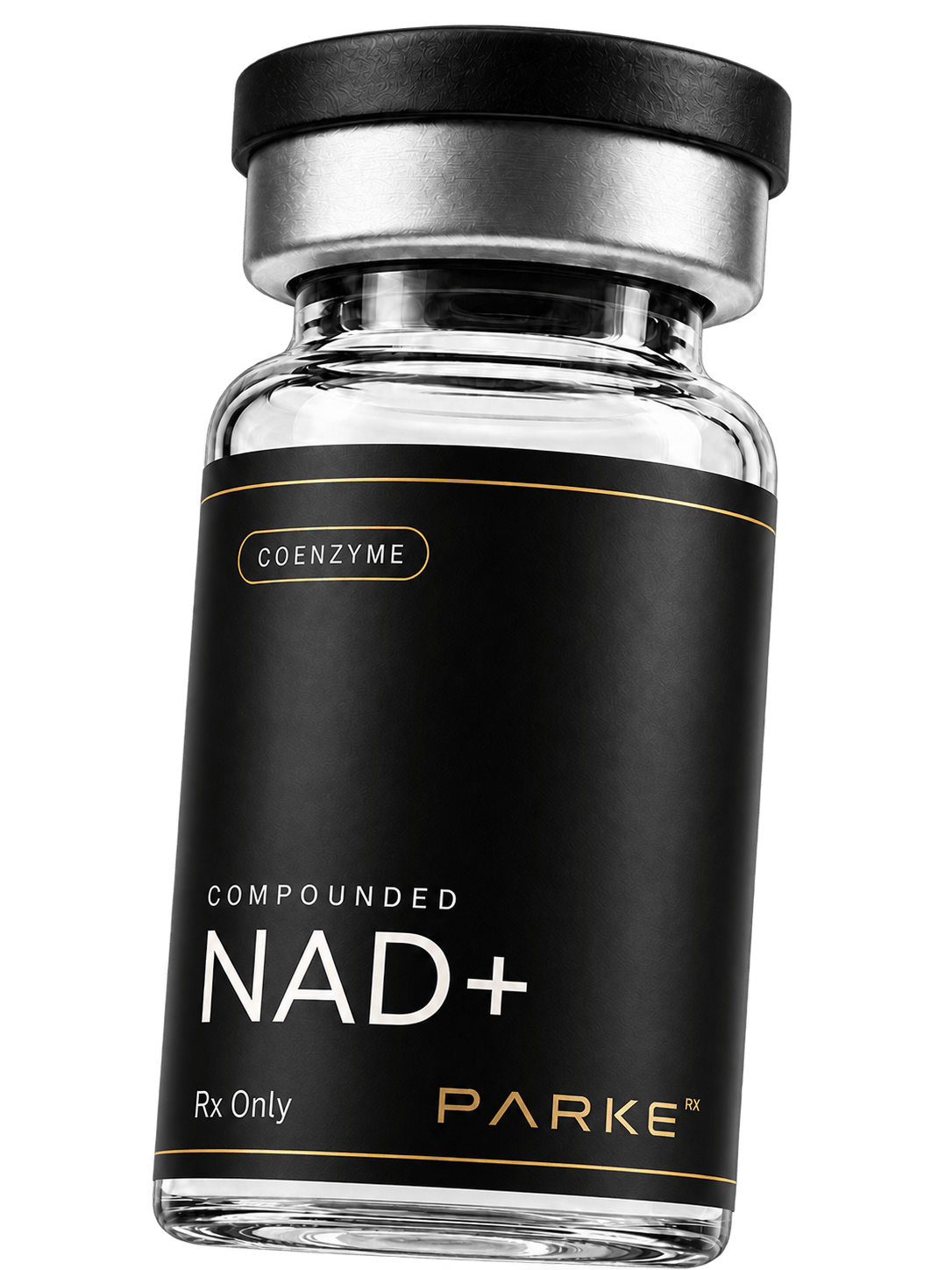


Rendering shown. Your prescription arrives in Parke's unmarked, temperature-controlled packaging. Compounded medications are not FDA-approved.
NAD+ RX
A weekly at-home injection of nicotinamide adenine dinucleotide, the coenzyme your cells use to turn food into energy. No IV chairs, no appointments, and a clinician who reviews every refill.
- A weekly protocol you run at home, not in a clinic
- Injected, so it bypasses digestion entirely
- Free discreet delivery, monthly or quarterly
- Unlimited clinician messaging between refills
Multi-month plans show the average monthly cost and are billed upfront. Your final plan and price are set with your clinician, and you can pause or cancel anytime.
A coenzyme, not a stimulant.
Here is what that means.
NAD+ is not a vitamin, a hormone, or a drug that pushes your system. It is a molecule your cells already use, every second, in the most basic work they do.
In every living cell
Nicotinamide adenine dinucleotide is a coenzyme found in every cell in your body. Without it, the chemistry that keeps cells running does not happen.
Turning food into energy
Its best-established role is in metabolism: NAD+ carries electrons in the reactions that convert what you eat into usable cellular energy.
Levels fall with age
Research consistently finds that NAD+ levels in human tissue decline as we get older. What that decline causes, and what reversing it does, is still being studied.
Why injected
Taken by mouth, NAD+ is broken down before it is absorbed intact. Injection puts it into circulation directly, which is why protocols use that route.
Established biochemistry, honestly framed.
Your clinician decides whether it fits you.
No IV chair.
No afternoon gone.
The clinic version of NAD+ means a drip, a chair, and hours of your week. Ours is a weekly injection you give yourself at home.
- One small injection, weekly. Same day each week, about 30 seconds, with guided instructions in your member portal.
- Go slowly the first time. Injected NAD+ can feel intense if given too fast. Your instructions cover pacing, and your clinician sets your dose accordingly.
- A clinician on your side of it. Questions between refills are answered by your care team, usually the same business day.
 Built for real life
Started low, then reviewed.
NAD+ protocols begin conservatively because tolerance varies more than most people expect. This is the typical arc, though yours may differ.
Finding your tolerance
A low starting dose, given slowly. Most people who feel flushing or a warm, heavy sensation feel it here, and it passes within minutes of finishing.
The working range
If the first weeks go smoothly, your clinician steps you up. This is where most members settle, and where they judge whether it is doing anything for them.
Only as long as it earns it
Continuing is a decision you revisit together. If you cannot tell the difference after a fair trial, your clinician will say so rather than keep shipping it.
Every step is reviewed. Refills at Parke are approved by the clinician who knows your chart, never by an auto-renewal system. Adjustments, including lowering your dose or pausing, are included in your plan. New to the word? Titration, explained, in the Journal.
Real biochemistry,
early clinical evidence.
NAD+ is present in every living cell and is required for the reactions that produce cellular energy. That part is settled science, taught in every biochemistry course.
What is well established is the biology: NAD+ is essential to energy metabolism, it participates in DNA repair and in the activity of enzymes involved in cellular maintenance, and its levels in human tissue decline with age.
What is not established is the clinical payoff. Most of the striking findings about raising NAD+ come from laboratory and animal studies, which frequently fail to translate to people. Human trials so far are small, short, and mixed, and none support marketing NAD+ as an anti-aging treatment, an energy cure, or a substitute for sleep, exercise, or medical care. Parke does not make those claims. Compounded NAD+ is not FDA-approved or evaluated. Individual results vary, many people notice nothing, and nothing here is guaranteed.
Same molecule. Very different week.
You don't have to choose alone. Your clinician weighs your history and your goals, and will tell you plainly if NAD+ is not the right place to spend your money.
On NAD+, in their words.
“I was driving forty minutes each way for drips. Now it is Sunday morning in my kitchen and the rest of the day is mine.”
“My clinician told me up front the evidence is early and I might feel nothing. I appreciated that more than a promise. For me the afternoons got easier.”
“The first one felt strange and warm and I panicked a little. I messaged at nine at night and had real instructions back before I went to bed.”
Individual results and experiences vary. Testimonials reflect the experiences of specific members and are not a guarantee of outcomes. Treatment is prescribed only when a licensed clinician determines it is appropriate.
Side effects, said plainly.
You deserve the whole picture before you start, not after.
Common, usually brief
- Flushing, warmth, or a heavy chest feeling during the injection
- Soreness, redness, or a small bruise at the injection site
- Nausea or stomach cramping, especially if given too quickly
- Lightheadedness or a brief headache
Rare, but serious: call your clinician
- Allergic reaction: hives, facial swelling, trouble breathing
- Chest pain, palpitations, or a racing heart that does not settle
- Injection-site pain or swelling that spreads or will not settle
- Fainting, or symptoms that persist well after the injection
How Parke handles this: the single most common cause of a rough NAD+ experience is going too fast, so your instructions cover pacing and your clinician sets a conservative starting dose. They screen your full history first, including heart, kidney, and liver conditions, and they are reachable between refills. Most side-effect questions are answered the same business day. Full details in the important safety information.
Asked, answered, plainly.
Can't find your question? Message us. A human on our care team replies, usually within a few hours.
Nicotinamide adenine dinucleotide is a coenzyme present in every cell in your body. Its central job is in energy metabolism: carrying electrons in the reactions that convert food into usable cellular energy. It also participates in DNA repair and in the activity of enzymes involved in cellular maintenance. At Parke it is prescribed as a compounded injectable preparation by a licensed clinician, when appropriate, and prepared by state-licensed US pharmacies.
We cannot promise that, and we would be suspicious of anyone who does. The biology is real and the age-related decline in NAD+ is well documented, but the human evidence that raising it produces meaningful benefits is early, small, and mixed. Some members describe steadier afternoons; others notice nothing at all and stop. Your clinician will set that expectation honestly before you spend anything, and will tell you when a fair trial has not worked.
It is the same molecule by a different route. A clinic infusion typically means two to four hours in a chair and several hundred dollars per session. The at-home weekly injection takes about thirty seconds and includes your clinician and messaging in one monthly price. Neither route has strong human outcome evidence, so the honest comparison is about cost and time, not about one being proven and the other not.
NMN and NR are precursors: your body converts them into NAD+. They are taken by mouth, are sold as supplements rather than prescriptions, and have their own early and inconclusive research base. NAD+ itself is not well absorbed intact by mouth, which is why prescribed protocols use injection. If a daily oral supplement suits you better, your clinician will say so.
Flushing, warmth, a heavy chest feeling, or mild nausea during administration are commonly reported with injected NAD+, and they are closely tied to speed. Given slowly, most people find it manageable, and the sensation typically fades within minutes of finishing. Your guided instructions cover pacing. If it feels rough at your current dose, message your clinician rather than pushing through.
Eligibility is a clinical decision made from your full intake. NAD+ is not prescribed during pregnancy or breastfeeding, or with certain cardiac, kidney, or liver conditions, or a known sensitivity to any component, among other factors your clinician reviews before any prescription is written. See the full eligibility page.
Everything: your medication and supplies, clinician reviews, dose adjustments, unlimited care-team messaging, and free discreet shipping. No membership fees, no hidden charges, no cancellation fees.
Anytime, from your member portal, in about two clicks. No contracts, no cancellation fees, no retention phone calls. Multi-month plans can be paused with your remaining shipments held.
Explore other concierge treatments.



Cellular health, considered honestly, starts with a conversation.
A private 2-minute assessment, read by a clinician who will decide with you: NAD+, something else, or nothing at all.
No charge unless a clinician approves your plan · Pause or cancel anytime
Important safety information: compounded NAD+ (nicotinamide adenine dinucleotide) injection
Do not use if you are allergic to nicotinamide adenine dinucleotide or any component of the preparation. Tell your clinician if you are pregnant, breastfeeding, or planning pregnancy; have heart disease, an arrhythmia, or high blood pressure; have kidney or liver disease; have a history of fainting or low blood pressure; or take any medications or supplements, including niacin. Commonly reported effects during or shortly after injection include flushing, warmth, chest tightness or heaviness, nausea, stomach cramping, lightheadedness, and headache; these are closely associated with administering the injection too quickly and typically resolve within minutes of finishing. Injection-site pain, redness, swelling, or bruising can occur. Rarely, allergic reactions (including hives, swelling of the face or throat, and difficulty breathing) can occur; stop use and seek immediate care if they do. Seek care for chest pain, palpitations, fainting, or spreading injection-site pain, warmth, or swelling.
Compounded NAD+ is prepared by state-licensed US compounding pharmacies and is not FDA-approved or evaluated by the FDA for safety, effectiveness, or quality. NAD+ has not been shown in rigorous human clinical trials to slow or reverse aging, to treat any disease, or to produce sustained increases in energy, cognition, or athletic performance; much of the widely cited research is preclinical or in animals and may not translate to people. Parke does not prescribe or market NAD+ as an anti-aging treatment or as a substitute for sleep, nutrition, exercise, or evaluation of any underlying medical condition, including causes of fatigue such as anemia, thyroid disease, or sleep apnea. This page is informational, is not medical advice, and does not guarantee any outcome. If you are experiencing a medical emergency, call 911.