
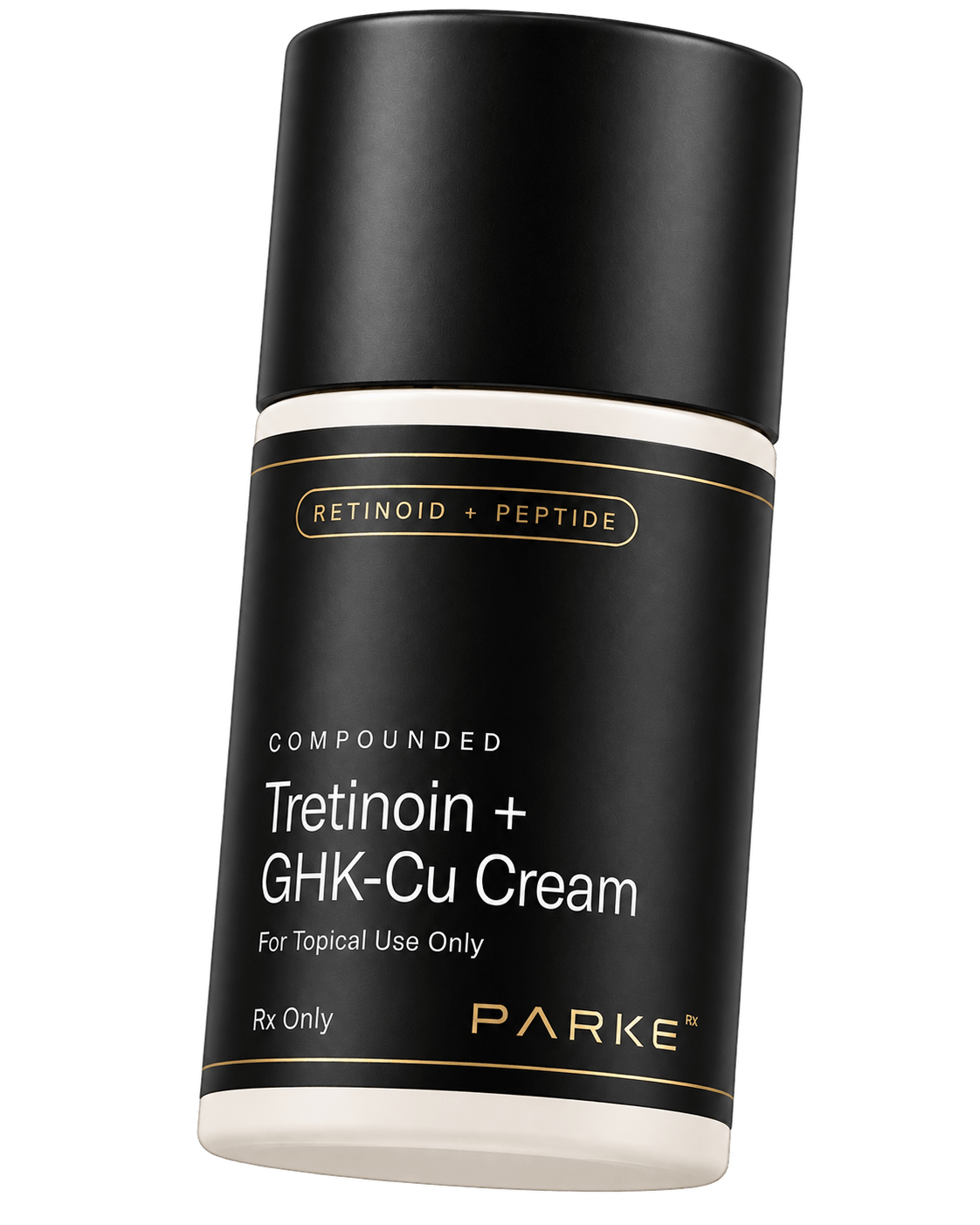


Rendering shown. Your prescription arrives in Parke's unmarked packaging. Compounded medications are not FDA-approved.
Tretinoin + GHK-Cu RX
One nightly cream, four named ingredients: a prescription retinoid, a copper peptide, caffeine, and niacinamide, with the strengths printed right here on the page. We describe what is in it and how to use it, and your clinician decides whether it fits you.
Tretinoin + GHK-Cu is a compounded medication, prepared for your prescription by Striker Pharmacy, a state-licensed US 503A compounding pharmacy. Compounded medications are not FDA-approved.
- 30 g of cream, a full 30-day supply, applied at night
- Strengths disclosed: caffeine 1% · GHK-Cu 3% · tretinoin 0.01%, with niacinamide
- Free discreet delivery, every month
- Unlimited clinician messaging between refills
Your final plan and price are set with your clinician, and you can pause or cancel anytime.
One cream.
Four named parts.
Tretinoin + GHK-Cu is a single nightly cream with four disclosed ingredients. Here is each one, described plainly.
The prescription retinoid
Tretinoin is a form of vitamin A, prescribed in US dermatology since the 1970s. It is included at 0.01%, a low strength, and it is the reason this cream requires a prescription.
The copper peptide
GHK-Cu is a small peptide found naturally in human plasma, bound to copper: the same molecule as our single-ingredient cream, included here at a stated 3%.
The caffeine
Yes, that caffeine. It has a long history as an ingredient in both prescription medicines and topical formulas, and it is included here at a stated 1%.
The supporting vitamin
Niacinamide is a form of vitamin B3 and one of the most widely used ingredients in modern skincare. It rounds out the base of the cream.
Composition and use, plainly described.
Your clinician decides whether it fits you.
A pea-sized amount,
then sleep.
One small amount at night, sunscreen in the morning. That is the whole routine, and both halves matter.
- A pea-sized amount, nightly. On clean, dry skin before bed, with guided instructions in your member portal. Tretinoin degrades in sunlight, which is why this cream works the night shift.
- Mornings mean sunscreen. A retinoid makes skin more sensitive to the sun. Daily SPF is not a suggestion alongside this cream; it is part of the protocol.
- A clinician on your side of it. Your clinician may start you at a few nights a week and build from there, and questions between refills are answered usually the same business day.
 Built for real life
A slow tissue, judged fairly.
Skin renews itself over weeks, not days, and retinoid routines ask for patience twice. The protocol is built around that honesty. Yours may differ.
Easing in
A pea-sized amount at night, often a few nights a week at first, building toward nightly as your skin settles in. Your clinician sets the pace, not the calendar.
Giving skin time
The early weeks of a retinoid can be the driest ones: flaking and mild redness are common while skin adjusts. That is expected, it is managed with your clinician, and it is why nobody should judge this in week two.
Only as long as it earns it
At the review you and your clinician decide together. If you cannot tell the difference after a fair trial, they will say so rather than keep shipping it.
Every refill is reviewed. Refills at Parke are approved by the clinician who knows your chart, never by an auto-renewal system. Adjustments, including pausing or stopping, are included in your plan.
Every strength, stated.
Caffeine 1%. GHK-Cu 3%. Tretinoin 0.01%. With niacinamide. Printed here because you should not have to guess what is in a prescription cream.
What is well established is each ingredient on its own: tretinoin has been a prescription dermatology staple since the 1970s, GHK-Cu has been studied in skin-biology laboratories for five decades, and caffeine and niacinamide are among the most familiar ingredients in topical formulas.
What is not established is the combination. This four-ingredient cream has not been studied as a whole in rigorous trials, and none of the research behind its parts supports marketing it with anti-aging, wrinkle, collagen, or firming claims, so Parke does not make them. What you receive is a compounded preparation, which is not FDA-approved or evaluated. Individual results vary, many people notice nothing, and nothing here is guaranteed.
Stated strengths, versus guessing.
You don't have to choose alone. Your clinician weighs your skin, your history, and your goals, and will tell you plainly if this cream is not the right place to spend your money.
On the cream, in their words.
“My clinician started me two nights a week and told me exactly what the first month of a retinoid feels like. Nothing about it was a surprise, which I have never been able to say about skincare.”
“I asked what the cream would do and got the most honest answer I have ever heard from a company selling one: here is what is in it, here is how to use it, the rest is between you and twelve weeks.”
“Sunscreen every morning was the habit I actually needed to build. The cream is two minutes; the review at week twelve was a real conversation.”
Individual results and experiences vary. Testimonials reflect the experiences of specific members and are not a guarantee of outcomes. Treatment is prescribed only when a licensed clinician determines it is appropriate.
Side effects, said plainly.
A retinoid asks more of your skin than a cosmetic does. You deserve the whole picture before you start.
Common, especially at first
- Dryness, flaking, or peeling, most noticeable in the first weeks
- Redness, warmth, or a mild sting where the cream is applied
- Itch, or a feeling of tightness after washing
- Increased sensitivity to the sun for as long as you use it
Stop and message your clinician
- Severe burning, blistering, or crusting where applied
- Swelling of the skin, or a rash that spreads beyond the application area
- Hives, facial swelling, or trouble breathing: seek immediate care
- Irritation that worsens instead of settling as the weeks pass
How Parke handles this: your clinician screens your full history first, including pregnancy or plans for it, since tretinoin is not used during pregnancy, the skincare you already use, since some products do not mix well with a retinoid, and any sensitivity to copper or other components. The cream is for external use only, kept away from the eyes, mouth, and broken or sunburned skin, daily sunscreen is part of the protocol, and your care team is reachable between refills, usually the same business day. Full details in the important safety information.
Asked, answered, plainly.
Can't find your question? Message us. A human on our care team replies, usually within a few hours.
Four named ingredients in one 30 g cream: tretinoin 0.01%, a prescription retinoid; GHK-Cu 3%, a copper peptide found naturally in human plasma; caffeine 1%; and niacinamide, a form of vitamin B3. It is prescribed by a licensed clinician, when appropriate, and prepared for your prescription by Striker Pharmacy, a state-licensed US 503A compounding pharmacy.
Each has a long, separate history in topical use, and combining them puts your evening routine in one step instead of three. That is a composition decision by our clinical team, described plainly: what the combination does beyond its parts has not been studied in rigorous trials, and we will not pretend otherwise. Your clinician will tell you whether the formula makes sense for your skin, or whether something simpler does.
No. Compounded medications are not FDA-approved, and this cream is no exception. Two of its ingredients, tretinoin and caffeine, are components of medicines that have been through the FDA approval process; topical GHK-Cu is on the FDA's list of substances under evaluation for 503A compounding. The combination itself is compounded per prescription, which is permitted because it is not a copy of any commercially available drug, and it has not been through the approval process. We say that plainly because you should not have to find it in a footnote.
Tretinoin degrades in sunlight, so it belongs in the evening, and a retinoid also makes skin more sensitive to the sun, so mornings belong to sunscreen. The two habits are a pair: a pea-sized amount at night, SPF the next day, every day you use the cream.
Honestly: the driest stretch of the whole protocol. Flaking, mild redness, and tightness are common while skin adjusts to a retinoid, which is why your clinician may start you a few nights a week rather than nightly. The copper peptide also keeps its natural blue tint in the cream; it applies sheer and settles clear. Whatever you might eventually notice arrives slowly, and the 12-week review is where you and your clinician judge it fairly.
No. Tretinoin is not prescribed during pregnancy, while trying to conceive, or while breastfeeding. Tell your clinician if any of those apply now or may apply soon; it is one of the first things they will ask, and it is a hard line rather than a judgment call.
Eligibility is a clinical decision made from your full intake. Beyond the pregnancy exclusion, the cream is not prescribed with a known sensitivity to tretinoin, copper, or any component, is not applied to broken, sunburned, or actively inflamed skin, and your current skincare and sun exposure are part of the review, among other factors your clinician weighs before anything is written. See the full eligibility page.
Everything: your medication, clinician reviews, unlimited care-team messaging, and free discreet shipping. No membership fees, no hidden charges, no cancellation fees, and you can pause or cancel anytime from your member portal.
Explore other concierge treatments.


A cream that tells you exactly what is in it starts with a conversation.
A private 2-minute assessment, read by a clinician who will decide with you: this cream, something else, or nothing at all.
No charge unless a clinician approves your plan · Pause or cancel anytime
Important safety information: compounded tretinoin + GHK-Cu topical cream
For external use only. Do not use if you are pregnant, trying to conceive, or breastfeeding: tretinoin is not prescribed in those circumstances. Do not use if you are allergic or sensitive to tretinoin, GHK-Cu, copper, caffeine, niacinamide, or any component of the preparation. Keep away from the eyes, mouth, and other mucous membranes, and do not apply to broken, sunburned, eczematous, or actively inflamed skin. This cream increases your skin's sensitivity to the sun: use a daily sunscreen, limit sun and UV exposure, and tell your clinician about the other skincare you use, since exfoliating or drying products can compound irritation. The most commonly reported effects are dryness, flaking or peeling, redness, warmth or stinging, and itch, most noticeable during the first weeks. Rarely, severe irritation or allergic skin reactions (including spreading rash, swelling, or blistering) can occur; stop use and contact your clinician if they do, and seek immediate care for hives, swelling of the face or throat, or difficulty breathing.
Tretinoin + GHK-Cu is compounded for Parke prescriptions by Striker Pharmacy, a state-licensed US 503A compounding pharmacy, and, like all compounded medications, is not FDA-approved or evaluated by the FDA for safety, effectiveness, or quality. Tretinoin and caffeine are components of FDA-approved medicines, and GHK-Cu is under FDA evaluation for use in 503A compounding, but this combination is compounded per prescription, has not been through the FDA approval process, and has not been studied as a whole in rigorous clinical trials. It has not been shown to reduce wrinkles, rebuild collagen, firm skin, or slow or reverse skin aging, and Parke does not prescribe or market it for those claims or as a substitute for sun protection, sleep, nutrition, or evaluation of any skin concern by a qualified professional. This page is informational, is not medical advice, and does not guarantee any outcome. If you are experiencing a medical emergency, call 911.