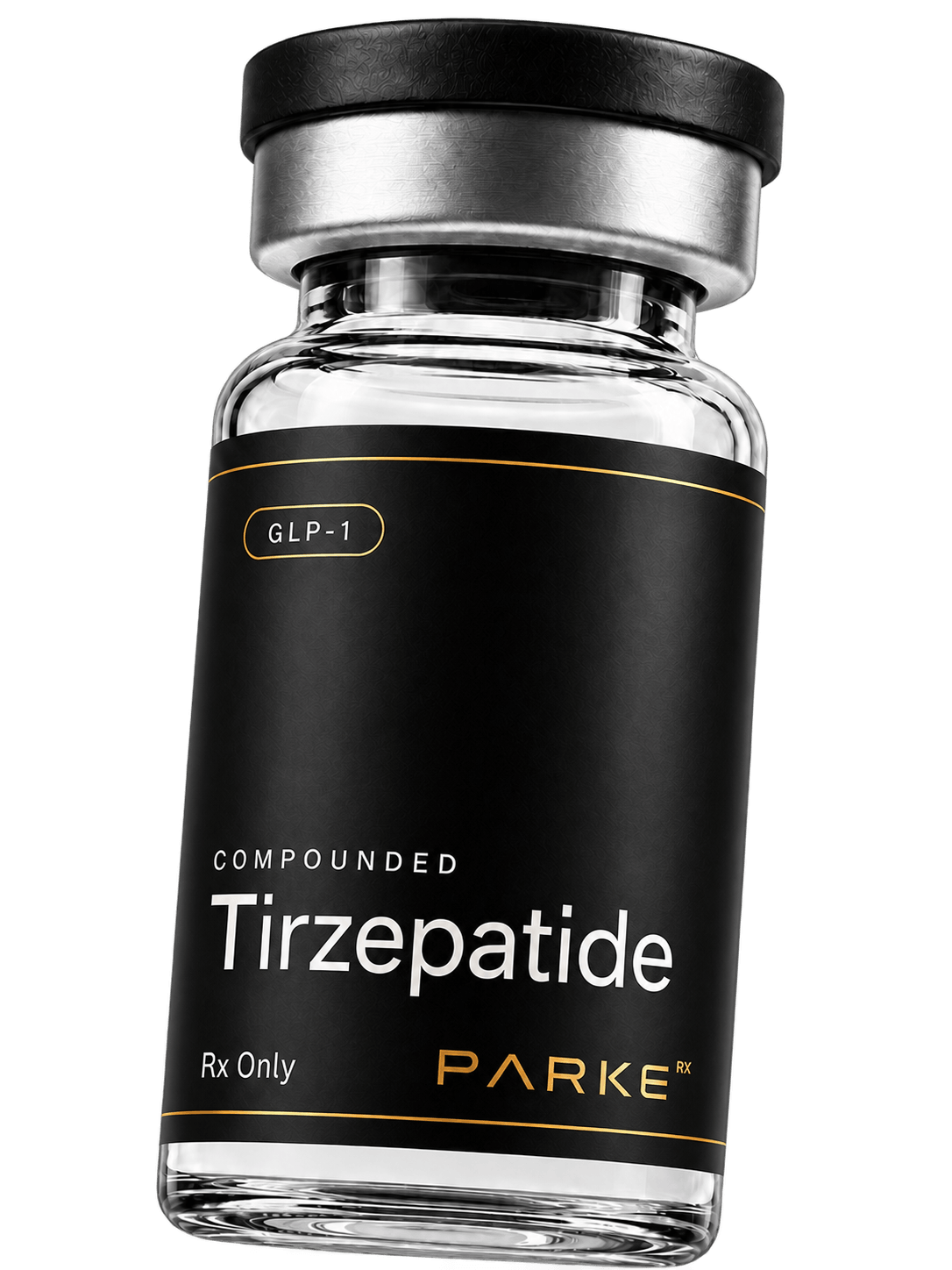
- Semaglutide for weight management climbs 0.25, 0.5, 1, 1.7, 2.4 mg; tirzepatide runs 2.5 to 15 mg in 2.5 mg steps.
- Four weeks per rung is a floor, not a schedule to race: levels take weeks to settle, and the gut adapts on the same clock.
- The top is a ceiling, not a target. Both labels choose maintenance by response and tolerability, and the middle rungs are real destinations.
- On the lowest tirzepatide maintenance dose, 5 mg, the branded trial averaged a 15.0 percent reduction, with 85.1 percent losing at least 5 percent.
- On a compounded vial, milligrams become units only through that vial’s printed concentration. No one else’s math applies.
The short answer
The semaglutide dose chart for weight management runs 0.25, 0.5, 1, 1.7, and 2.4 mg once weekly, climbing one step every 4 weeks; the tirzepatide chart runs 2.5 to 15 mg in 2.5 mg increments, each step held at least 4 weeks. Those two ladders, published in the FDA labels of the branded products and current on DailyMed, are the entire architecture of GLP-1 dosing, and every rung exists for a reason worth knowing.
This is a reference article. The charts are below, then the logic: why the four-week rule is load-bearing, why plenty of people never see the top rung and are not supposed to, and how compounded vials translate the same milligrams into units. What this article deliberately is not is dosing advice; your protocol comes from your clinician, and the labels are the boundary of everything said here.
The semaglutide dose chart: 0.25 to 2.4 mg
The weight-management label escalates on a fixed calendar:
| Weeks on treatment | Weekly dose |
|---|---|
| Weeks 1 to 4 | 0.25 mg |
| Weeks 5 to 8 | 0.5 mg |
| Weeks 9 to 12 | 1 mg |
| Weeks 13 to 16 | 1.7 mg |
| Week 17 onward | 2.4 mg maintenance, or 1.7 mg |
Two annotations make the chart honest. First, 0.25 mg is described by the labels as a starting dose, not an effective one; its job is to introduce your gut to the mechanism, which is why staying there is never the plan. Second, the maintenance line has two entries on the current label: 2.4 mg is the recommended maintenance dose, and 1.7 mg is a recognized maintenance option when tolerability argues for it. The label tells prescribers to weigh treatment response and tolerability in selecting maintenance, which is the sentence doing the most work in the whole document.
The type 2 diabetes label for semaglutide climbs a different, shorter ladder, 0.25 to 0.5 to 1 to a maximum of 2 mg, a reminder that the same molecule is dosed by indication, and that a chart borrowed from a different label is the wrong chart.
If a rough patch arrives on the climb, the label's own answer is time at a rung, not white-knuckling; our titration explainer covers how clinicians slow, hold, or step back without losing the plot.
The tirzepatide chart: 2.5 to 15 mg
Tirzepatide's weight-management label uses more rungs with the same rhythm:
| Step | Weekly dose |
|---|---|
| Start, weeks 1 to 4 | 2.5 mg |
| Step 2 | 5 mg |
| Step 3 | 7.5 mg |
| Step 4 | 10 mg |
| Step 5 | 12.5 mg |
| Ceiling | 15 mg |
The label starts everyone at 2.5 mg for 4 weeks, then allows increases in 2.5 mg increments after at least 4 weeks on the current dose. Its stated maintenance doses for weight reduction are 5, 10, or 15 mg, with the same instruction to weigh response and tolerability, and 15 mg is the maximum. As with semaglutide, 2.5 mg is billed as treatment initiation rather than a destination.
Notice what the two charts share: a deliberately sub-therapeutic opening month, roughly month-long rungs, a maintenance zone rather than a single mandatory summit, and a hard ceiling. The tirzepatide page covers what distinguishes the molecule itself, a dual-hormone mechanism; the ladder logic is identical.
The four-week minimum between steps
The four-week rule is the least negotiable line on either chart, and it is physiology, not bureaucracy.
These are long-acting molecules; after a dose change, blood levels climb for weeks before flattening at the new plateau. Judge a rung at day six and you are judging a dose you do not fully have yet. Four weeks is roughly what it takes for levels to settle and, just as important, for the gut to adapt, since the labels report that nausea and its relatives cluster during escalation and ease with time at a stable dose. The tirzepatide label's phrasing is precise: increase only after at least 4 weeks on the current dose. At least is the operative phrase; four weeks is a floor, not a schedule to race.
The rungs themselves are not arbitrary either. Each approved dose earned its place in dose-finding trials, where the manufacturers tested a spread of doses and mapped effect against tolerability; the ladder the label prints is the surviving route through that map. That is why the steps are not evenly spaced in effect: the jump from 0.25 to 0.5 mg roughly doubles a tiny dose to introduce the gut gently, while the top steps add smaller relative increases to a system already near its working range. A chart that looks like simple arithmetic is actually a compressed summary of years of trial data about what bodies accept and when.
Climbing faster does not buy faster results, because the medication was still arriving at the old rung when you left it. What it reliably buys is the side-effect profile of a dose your body had not accepted yet, and, for a fraction of people each year, an avoidable quit. Slow is not the cautious version of the protocol. Slow is the protocol.
The four-week floor also protects the judgment that matters most: whether a rung is your maintenance dose. Appetite effect, side effects, and the scale all need settled weeks to give a clean reading, and a member who climbs on the earliest possible day every month reaches the ceiling having never actually observed a single rung at steady state. Clinicians who slow a ladder are usually not treating a problem; they are buying the information that prevents one.
Why some people stay on a middle dose
The top of the chart is a ceiling, not a target, and the labels say so in plain words: select maintenance by response and tolerability.
Plenty of members find their working dose in the middle rungs, appetite quieted, progress steady, side effects minimal, and simply stay. The trial data support the middle as a real destination, not a consolation: in the 72-week trial reported on the branded tirzepatide label, the 5 mg arm, the lowest maintenance dose, averaged a 15.0 percent body-weight reduction, with 85.1 percent of participants losing at least 5 percent. Branded, FDA-approved product, not compounded preparations, and averages rather than promises, but the point stands: the lowest maintenance rung carried most of the effect for most people.
The clinical logic is the lowest effective dose: the least medication that holds the result, which usually means the fewest side effects and the most sustainable protocol. Moving up is warranted when progress stalls at a settled dose and the stall checklist has been walked first; staying put is warranted when the current rung is doing the job. Both are the chart working as designed, and this is exactly why Parke's quarterly plans keep a clinician re-reading your dose at every refill instead of escalating on autopilot.
Units, milligrams, and the compounded vial conversion
Branded pens hide the arithmetic: the device delivers the labeled milligrams, and no math survives contact with the user. A compounded vial hands the arithmetic back. It contains a concentration, milligrams of medication per milliliter of solution, and you draw a volume with an insulin syringe marked in units, where 100 units equal 1 milliliter.
The conversion is therefore three numbers chained together: your prescribed milligrams, your vial's concentration, and the units that volume occupies on the syringe. And here is the only safe universal statement: the conversion depends entirely on your vial's printed concentration, which varies between pharmacies and between preparations. The same 0.5 mg dose is a different number of units from a 1 mg/mL vial than from a 2.5 mg/mL vial. Your Parke protocol card states your dose in milligrams and in units for the specific vial you were shipped; that card, and the vial label it is built from, are the only two documents your syringe should ever obey.
What the conversion is not: transferable. A cousin's vial, a forum's chart, or last quarter's paperwork can all be arithmetically correct for their vial and wrong for yours. When a new shipment arrives, read the concentration before the first draw, and if the units on your card and the label on your vial seem to disagree, stop and message your clinician; that is a two-minute check that exists to be used. Reading the compounded label walks through every line on the paperwork.
Compounded medications are prepared by state-licensed US compounding pharmacies and are not FDA-approved or evaluated for safety, effectiveness, or quality.
“The chart is public. Your place on it is not. The right rung is the lowest one that holds your result, and that is a decision we make together.”
Dr. Priya Shah, MD
When to message your clinician
Message through the portal, rather than adjusting anything yourself, when: a rung's side effects are not settling after the first week or two; you have reached week four feeling fine and want the next step scheduled; progress has stalled at a settled dose and you suspect the rung, not the routine; you are unsure how many units your dose is on a newly arrived vial; or you have missed doses and the ladder needs recalibrating, which pairs with the missed-dose rules. Every one of these is a routine exchange at Parke, where no dose changes without a clinician reading your chart, and none of them should ever be solved by improvising with a syringe.
The bottom line
The semaglutide dose chart runs 0.25 to 2.4 mg; tirzepatide's runs 2.5 to 15 mg; both climb in month-long rungs with four weeks as the floor, both treat the top as a ceiling rather than a destination, and both instruct prescribers to pick maintenance by response and tolerability. On a compounded vial, the same milligrams become units only through your vial's printed concentration, never through anyone else's math. All of it comes from the labels of the branded, FDA-approved products, not compounded preparations, and none of it substitutes for the clinician who assigns your rung.
If you want the ladder with the clinician attached, tirzepatide and semaglutide at Parke both include titration reviewed at every refill, and eligibility takes about two minutes.
The semaglutide dose chart: frequently asked questions
What is the highest dose of tirzepatide?
The branded tirzepatide label's maximum is 15 mg once weekly, reached by 2.5 mg increments with at least 4 weeks on each dose. It is a ceiling, not a goal: the label lists 5, 10, and 15 mg as maintenance doses and instructs prescribers to choose based on response and tolerability. Many people maintain well below the maximum.
Do I have to reach the maximum dose?
No. Both labels define maintenance as a decision weighing treatment response against tolerability, and the trial data reported on the tirzepatide label show the lowest maintenance dose, 5 mg, averaged a 15.0 percent body-weight reduction over 72 weeks in the branded product's trial. The lowest dose that holds your result is the clinically preferred rung, not a compromise.
How do I convert units to milligrams on a compounded vial?
Only through your own vial's label. The conversion runs prescribed milligrams through the vial's printed concentration to a syringe volume in units, and concentrations vary by pharmacy and preparation. Your Parke protocol card states your dose in both figures for the exact vial shipped. Never reuse another vial's conversion, and message your clinician if card and label disagree.
Endocrinologist at Parke, focused on the hormonal machinery of appetite and metabolism. She reviews the science claims in this journal alongside the medical director.
- DailyMed (NIH): current FDA-approved prescribing information for branded semaglutide 2.4 mg injection, the source for the escalation schedule and maintenance options.
- DailyMed (NIH): current FDA-approved prescribing information for branded tirzepatide injection, the source for the 2.5 mg steps, the four-week minimum, and the 5 mg arm results.
This article is general education, not medical advice, and it is not a complete list of risks or side effects. Trial figures cited here come from studies of branded, FDA-approved products; compounded medications are prepared by state-licensed US compounding pharmacies and are not FDA-approved or evaluated for safety, effectiveness, or quality. Whether any treatment is appropriate for you is a decision made with a licensed clinician who knows your history. If you are experiencing a medical emergency, call 911. Review the important safety information on each treatment page.