
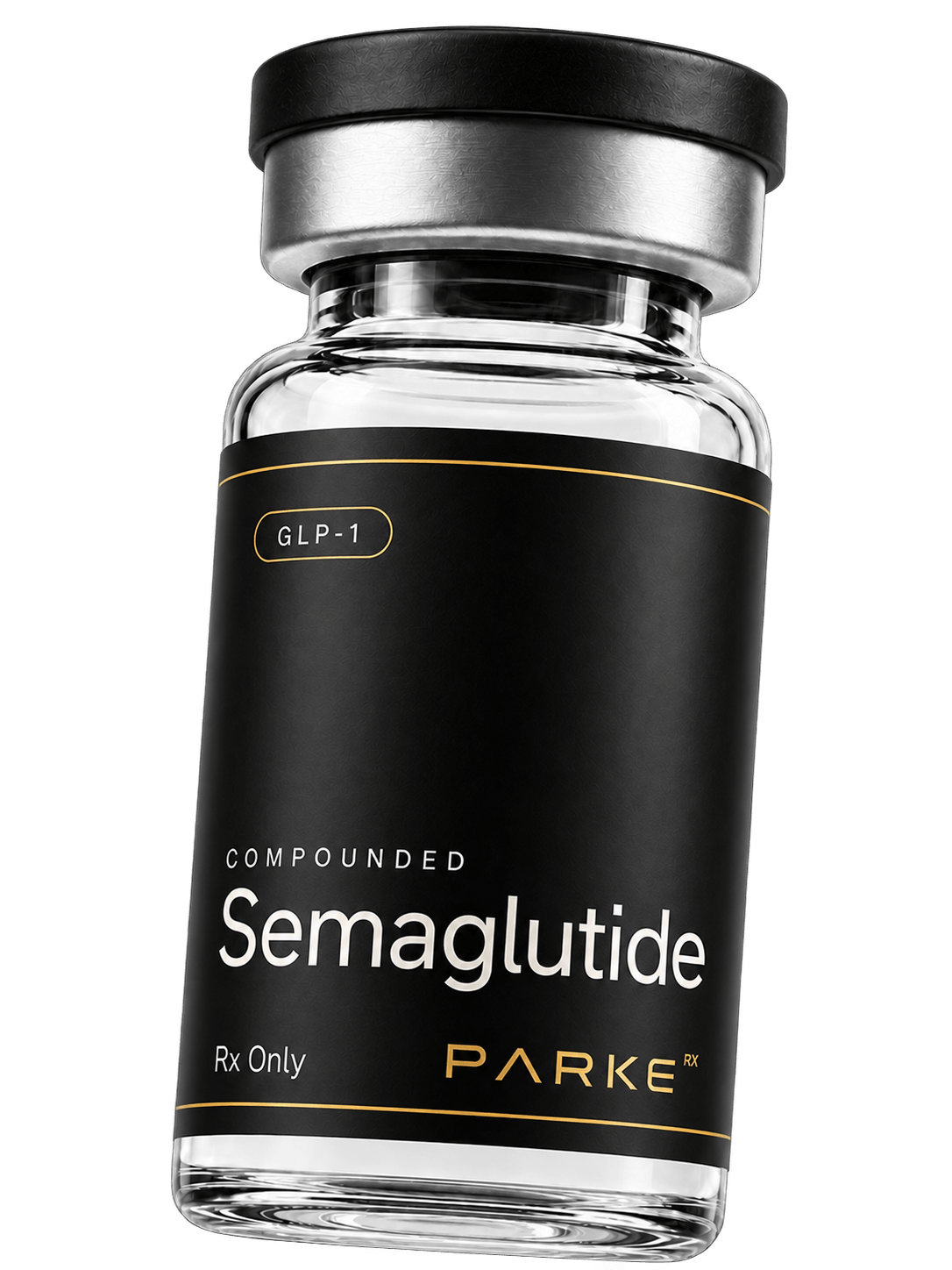
- "Microdosing" a GLP-1 usually means taking doses below the studied levels, stretching the weekly interval, or both.
- The trend runs on real pressures: cost, fear of side effects, social media momentum, and a wish for subtle rather than dramatic effects.
- The trial results that made these medications famous come from specific studied doses. Microdosing as a strategy has no FDA-approved dosing basis and little clinical validation, and lower exposure generally means smaller effects.
- The DIY version adds its own hazards: dosing math errors, splitting doses from unregulated vials, contamination, and gray-market product.
- The legitimate idea inside the trend already exists in medicine. It is called titration: finding the lowest effective dose, with a clinician.
- At Parke, cost and side-effect concerns are protocol conversations, raised in the portal and answered with an adjusted plan, not freelance pharmacology.
What people mean by microdosing
The word is borrowed from the psychedelics world, and like most borrowed words it arrived without a precise definition. In practice, people who say they are microdosing a GLP-1 mean one or more of three things: taking a dose below the lowest studied maintenance level, staying at an early titration dose indefinitely instead of stepping up, or stretching the interval, injecting every ten days or two weeks instead of weekly.
Sometimes this happens inside a clinician relationship, as a deliberate, monitored choice. Increasingly, it happens outside one: a vial obtained from somewhere, a syringe, a calculator, and a plan assembled from social media posts. Those are two very different activities wearing the same name, and most of this article is about keeping them apart.
This page covers the trend across the class. If you are weighing the idea for a specific molecule, we go deeper in the semaglutide edition and the tirzepatide edition of this guide.
Why the trend exists, honestly
It would be easy, and lazy, to wave this off as an internet fad. The pressures underneath it are real, and naming them is fairer than mocking them.
Cost. These medications are expensive, and for many people insurance does not help. Taking half the dose looks like paying half the price. When the alternative is stopping entirely, stretching a supply feels less like recklessness and more like arithmetic. We wrote about the payment side of this candidly in the cash-pay guide.
Side-effect fear. Everyone has heard a rough-week story: nausea, fatigue, food aversion. A smaller dose promises a gentler ride, and for people who quit a previous attempt because of side effects, that promise is powerful.
Social media momentum. The posts write themselves: fewer side effects, lower cost, "all I need." Anecdotes travel faster than trial data, and a feed full of people who say a sliver of a dose changed their life is persuasive in a way a journal article is not.
The wish for subtlety. Some people do not want dramatic weight loss. They want the edge taken off food noise, a smaller appetite, a little help. A "micro" dose sounds proportionate to a modest goal, and that intuition, dose matching intention, is not crazy. It is just incomplete.
What the evidence actually says
Here is the uncomfortable center of the topic. The results that made GLP-1 medications famous were produced at specific, studied doses, reached on specific schedules, in large randomized trials. In the trial registered as NCT03548935, participants on weekly semaglutide at the full studied maintenance dose lost an average of 15.6 percent of body weight over 68 weeks. In SURMOUNT-1, participants at the highest studied tirzepatide dose lost 20.9 percent on average over 72 weeks. Both figures come from branded, FDA-approved products under trial conditions, not compounded preparations, and individual results vary widely around any average.
What does the evidence say about doses below those levels, held there on purpose? Much less. The early, low doses in these trials were waypoints on the climb, not destinations, so the trials were never designed to answer how a permanent low dose performs. Microdosing as a strategy has no FDA-approved dosing basis, and the clinical literature validating it is thin to absent. That does not prove a low dose does nothing. Dose-response is a spectrum, not a cliff, and some people genuinely respond at low levels. It proves something narrower and more important: nobody can tell you with evidence what a given fraction of a dose will do, and the honest default is that lower exposure generally means smaller effects.
So the trade being advertised, most of the benefit for a fraction of the cost and side effects, is not what the evidence describes. The real trade is: an unknown fraction of the benefit, for a known fraction of the cost. Sometimes that trade is still worth making. But it should be made with open eyes, and with someone qualified watching the results.
“The legitimate idea inside this trend is real medicine, and it already has a name. It is called titration, and the difference is that it comes with a clinician attached.”
Dr. Alana Reyes, MD
The DIY version's real dangers
Everything above concerns the strategy. The bigger problem is the method most microdosing actually uses, because the trend largely lives outside clinician relationships, and the DIY version stacks hazards that have nothing to do with dose philosophy.
Dosing math errors. Splitting doses means converting between milligrams, milliliters, and syringe units, sometimes across products with different concentrations. A misplaced decimal point in that arithmetic is not a rounding error; it can be a tenfold overdose. This class of mistake is exactly what the FDA has warned about with unapproved GLP-1 products drawn from vials.
Unregulated product. Much of the DIY supply comes from sources marketing "research use" vials, products that were never intended for human use, never inspected for sterility, and never verified to contain what the label claims. Contamination, wrong concentrations, and wrong substances entirely have all been documented in this gray market. If you want to understand what a legitimate compounded label looks like and how to read one, we wrote a full field guide.
No one watching. Even with clean product and correct math, a self-directed protocol has no monitoring: no one screening your history for reasons this medication is wrong for you, no one adjusting when something unexpected happens, no one to message at 9pm. The absence of a clinician is not a cost saving. It is the removal of the safety system.
Notice that none of these dangers come from the idea of a low dose. They come from doing pharmacy work and clinical work yourself, without the training, the equipment, or the accountability of either profession.
The steelman: the good idea already has a name
Strip away the sourcing problems and the syringe math, and the defensible core of microdosing is this: the right dose is the lowest one that achieves your goal, and for some people that is lower than the standard maintenance target. That idea is not fringe. It is a cornerstone of ordinary prescribing, and in this class of medication it has a formal process: titration.
Titration starts every member low, steps up on a schedule, and, crucially, stops climbing when the clinical picture says stop. If your appetite is controlled, your progress is steady, and your side effects are quiet at a lower level, a clinician can hold you there. That is the monitored, legitimate version of everything the trend wants: minimum effective dose, gentler side-effect profile, and yes, often a lower cost, because dose and price are related. The difference is that each of those outcomes is verified against your actual results rather than assumed from a stranger's post. We explain the whole process in the titration guide.
The trend, at its best, is a demand for exactly this. The tragedy is that people are assembling a worse copy of it at home, from worse materials, without the one ingredient that makes it safe.
How Parke handles the dosing conversation
Here is what this looks like inside a clinician relationship, because the mechanics matter. If cost is the pressure, say so in the portal, in those words. Clinicians cannot solve a problem they have not been told about, and there are legitimate levers: holding at a lower effective dose where clinically appropriate, and quarterly plans that lower the average monthly price. If side effects are the pressure, describe them specifically. Slowing the climb, pausing at a step, or stepping back down are all standard moves, and your clinician would rather make them than have you make silent ones.
What nobody does at Parke is freelance their own pharmacology. Doses are set by the clinician who read your intake and your check-ins, prepared by a vetted, US-licensed pharmacy at a labeled concentration, and adjusted through the same channel that set them. That is not rigidity for its own sake. It is the entire difference between the version of this idea that is medicine and the version that is a forum thread.
The smarter version of the same instinct
Pull the threads of this article together and they point somewhere specific. The two honest motives behind microdosing are cost and the fear of side effects. Parke's answer to both is not a smaller syringe bought from a stranger. It is the 3-month quarterly plan, and it is worth spelling out why that is the same instinct, executed properly.
On side effects and dose, the quarterly plan is titration with a schedule attached. A clinician starts you low, climbs only as your results ask for it, and holds at the lowest effective dose, which is the outcome the microdosing trend is chasing. The provider medical check-in each quarter is what keeps that dose honest: four times a year, someone qualified looks at your progress, your side effects, and your goals, and confirms the dose still earns its place or adjusts it. A self-directed microdose gets decided once and audited never. A quarterly dose gets re-earned every season.
On cost, committing quarterly is simply the economical way to buy treatment here. Quarterly plans price below monthly on every treatment; on tirzepatide, for example, the 3-month plan runs $279 per month against $299 month to month, with the exact tiers on each treatment page and your plan confirmed in writing before any charge. That will not match the imagined price of a split vial. It is, instead, a real number for the real thing: labeled concentrations from a vetted, US-licensed pharmacy, a clinician watching the result, and no arithmetic done over a kitchen counter. The fuller case for the rhythm is in the quiet case for quarterly refills.
If the microdosing posts appealed to you, notice what they were really promising: less medication, fewer side effects, lower cost, more control. Every item on that list is available with supervision. That is the version we recommend.
The bottom line
The impulse behind microdosing is reasonable. Wanting the least medication that meets your goal is not a hack; it is good instinct, and good prescribing agrees with it. The unsupervised method is where the trend goes wrong: unvalidated dosing built on unregulated product, checked by nobody.
If the idea appeals to you, take the instinct and leave the syringe math. Tell a clinician what you are optimizing for, whether that is cost, comfort, or subtlety, and let the protocol, ideally a quarterly one, be built around it. The lowest dose that works is a clinical finding. It is discovered with supervision, not guessed at a kitchen counter.
Medical Director at Parke. Board-certified in internal medicine, with a decade of clinical practice focused on metabolic health. She reviews every clinical claim in this journal before it publishes.
- ClinicalTrials.gov, NCT03548935: the registered results for weekly semaglutide at the full studied dose, including the 15.6 percent mean change at 68 weeks cited above.
- New England Journal of Medicine: SURMOUNT-1, tirzepatide in adults with obesity, the source of the 20.9 percent figure.
- FDA: the agency's concerns with unapproved GLP-1 drugs used for weight loss, including dosing errors with products drawn from vials.
- FDA: Compounding and the FDA, questions and answers on the 503A framework.
This article is general education, not medical advice, and it does not recommend any dose or dosing strategy. Trial results cited reflect branded, FDA-approved products under study conditions, not compounded preparations, and individual results vary. Compounded medications are prepared by state-licensed US compounding pharmacies and are not FDA-approved or evaluated. All treatment and dosing decisions at Parke are made by a licensed clinician from your intake and check-ins. Review the important safety information on each treatment page.