
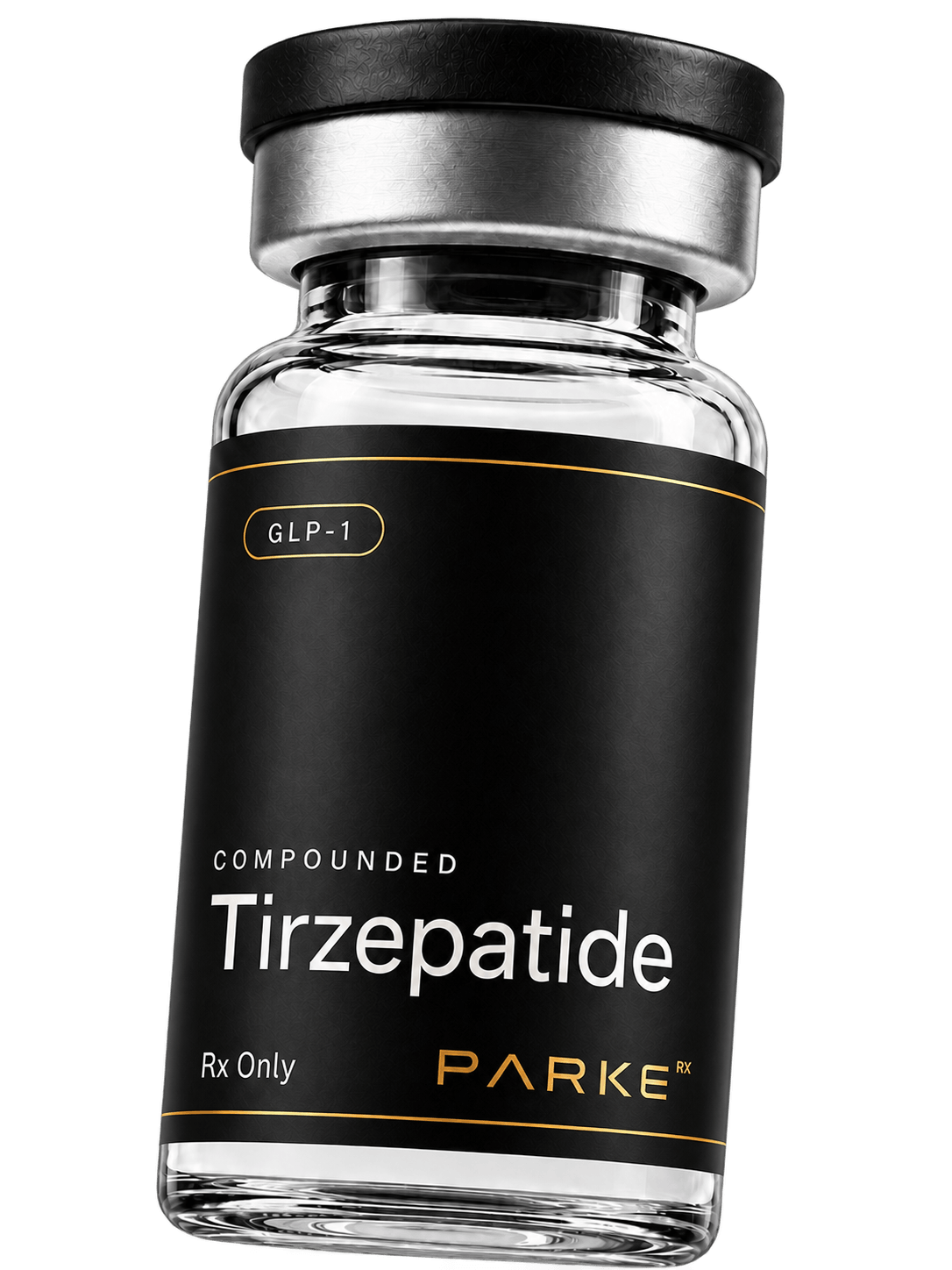
- Microdosing tirzepatide means holding the ladder's lowest steps, splitting doses from compounded vials, or stretching the weekly interval.
- The trend has a tirzepatide flavor: the molecule's trial results are the strongest in the class and its price runs higher, so both the sliver logic and the cost motive are sharper.
- The evidence covers a studied ladder on branded product, up to a 20.9% average weight change at 72 weeks. Below the ladder, nothing rigorous exists.
- Tirzepatide is a dual agonist built for weekly dosing around a half-life of about five days; stretched intervals sag rather than settle.
- The supervised version exists: clinician-guided titration to the lowest effective dose, re-examined at a provider medical check-in each quarter.
What microdosing tirzepatide means in practice
Microdose is not a clinical term, and when people apply it to tirzepatide they usually mean one of three things. Holding the lowest steps of the dose ladder indefinitely, taking the on-ramp dose and never merging. Splitting doses out of a compounded vial: drawing half or a quarter of the prescribed amount with an insulin syringe, so a month of medication stretches to two or three. Or stretching the interval itself, injecting every ten days or two weeks instead of weekly.
Any of those can be a deliberate, monitored decision made with a clinician. On the internet, they are more often a solo project: a vial of uncertain origin, a unit conversion, and a protocol assembled from other people's posts. Keeping those two versions apart is most of what this article is for. This is the tirzepatide edition of a larger guide; the trend across the whole class is covered in the full explainer.
Why the tirzepatide version has its own flavor
Every GLP-1 gets microdosed somewhere on the internet, but the tirzepatide version of the trend has two distinguishing marks. The first is the sliver assumption. Tirzepatide is, by trial results, the stronger molecule: the class's biggest average weight reductions were posted under its name. From there the reasoning feels like arithmetic: if the full dose moves the average that far, a quarter of it must still be plenty. But pharmacology is not a recipe you can quarter. Receptor effects do not scale down in tidy proportion, and, as the next section shows, nobody has published what a sliver of tirzepatide reliably does. The strength people are trying to fraction was measured at full, studied doses, and it belongs to them.
The second mark is money. Tirzepatide generally costs more than semaglutide wherever you buy it; at Parke the published starting prices tell the same story, tirzepatide from $249 a month against semaglutide from $133. A higher price makes stretching a vial feel less like a hack and more like a necessity, so the cost motive that drives all microdosing runs sharper here. That motive is honest, and it deserves an honest answer rather than a lecture. We will get to ours.
What the tirzepatide evidence actually covers
Tirzepatide's reputation rests on trials of the branded, FDA-approved product at specific weekly doses reached by a set escalation schedule. In SURMOUNT-1, which ran 72 weeks, adults with overweight or obesity averaged body-weight reductions of 15.0% at the 5 mg weekly dose, 19.5% at 10 mg, and 20.9% at 15 mg, versus 3.1% with placebo.
Read that spread again, because it contains the trend's strongest legitimate argument and its limit in the same line. The lowest studied maintenance dose, 5 mg, averaged 15.0%: the trial's own low arm did remarkably well. But that arm is not a microdose. It is a full studied rung, reached by the scheduled climb, injected weekly, on branded product. The trial says a modest dose of tirzepatide can be enough for many people. It says nothing about the sliver-and-stretch versions that borrow its numbers.
Below the ladder, the record simply stops. There are no rigorous trials of tirzepatide below its studied doses or on stretched schedules, for weight, longevity, or anything else. What circulates instead is anecdote and extrapolation. Absence of evidence is not proof of absence, but it is absence of receipts, and receipts are what the trend keeps claiming to have.
Two receptors, one weekly rhythm
Tirzepatide's strength has a mechanism. Where semaglutide activates one receptor, GLP-1, tirzepatide activates two: GLP-1 and GIP, both part of the gut-hormone system that manages appetite and blood sugar after meals. The double signal is the leading explanation for the larger trial results. If the machinery is new to you, the plain-language mechanism guide walks through it properly.
The molecule is also engineered for a rhythm. Per its FDA prescribing information, tirzepatide binds to albumin in the blood, which slows its clearance to an elimination half-life of approximately five days, and that number is precisely what makes once-weekly dosing work: each injection arrives as the previous one fades, holding your level in a designed band. Stretch the interval to ten or fourteen days and the band breaks. Levels sag through the back of each cycle, so you spend days below any dose a clinician would prescribe, then jump when the next injection lands. And note the direction of the math: five days is a shorter half-life than semaglutide's roughly one week, which means a stretched tirzepatide schedule sags faster, not slower. The stronger molecule is, if anything, less suited to the stretching trick that its strength inspires.
“Change the dose and the rhythm at once and you are not taking a smaller version of the trial drug. You are taking a different, unstudied thing.”
Dr. Priya Shah, MD · Endocrinology
What the DIY version actually risks
The tirzepatide gray market has the same anatomy as the semaglutide one, with higher prices raising the stakes. The FDA has warned about fraudulent compounded tirzepatide sold with false information on the label, including compounding pharmacies that do not exist, alongside research-use peptides never meant for a human arm. A legitimate compounded prescription, prepared by a state-licensed 503A pharmacy against a prescription with your name on it, is a different object entirely, and you can learn to tell them apart in our guide to reading a compounded label.
Then there is the math. Splitting doses from a vial means converting between milligrams, milliliters, and insulin-syringe units, with concentrations that vary from product to product. The FDA has received reports of adverse events, some requiring hospitalization, that may be related to dosing errors with compounded GLP-1 medications: people drawing the wrong amount, and in some cases the professionals helping them miscalculating. One misplaced decimal is a tenfold error, and with a medication that stays in your system for weeks, an overdose runs long. The higher cost of tirzepatide adds its own quiet hazard: the temptation to stretch a vial past the point where it should have been discarded.
And through all of it, nobody is watching. No one adjusting the dose against what your body reports, no one triaging side effects, no one to message when a rough week arrives. With the stronger molecule, flying without instruments is a worse idea, not a better one.
The legitimate kernel
Strip away the method and the instinct underneath is sound: response varies from person to person, and plenty of people do well on less than the maximum. The SURMOUNT arms already hinted at it, and clinical practice confirms it daily. Many Parke members stay at tirzepatide's lower rungs deliberately, under clinician guidance, because that is where their results and their side effects balance. The trend would call them microdosers. Their charts call it the right dose.
The tool that finds that dose is titration: start low, climb only while the evidence says climb, stop at the lowest dose that delivers real effect with side effects you can live with, and step back down when that is the honest call. On the stronger molecule, the case for a careful ladder is stronger too. Microdosing is titration with the measurement removed; the fix is not a bigger dose, it is putting the measurement back.
The supervised path already exists
None of this requires improvising, because the supervised version of tirzepatide treatment is a thing you can simply start. Parke's tirzepatide protocol begins with a private intake read by a licensed clinician within 24 hours, and there is no charge unless you are approved. Your clinician sets the starting dose, runs the climb at your body's pace, and answers messages between refills. The medication comes from a vetted, US-licensed 503A pharmacy with a label you can read and a chain of custody you never have to wonder about. Everything the DIY version improvises, the protocol simply includes.
The smarter version of the instinct
People microdose tirzepatide for two honest reasons: it costs real money, and the side-effect stories are scary. Here is how both get answered without a syringe chart from the internet.
The side-effect fear is answered by titration, as above: the target of the whole system is your lowest effective dose, not the top of the ladder. The dose staying right over time is answered by the plan's rhythm. On a quarterly plan, every refill includes a provider medical check-in, a structured review done online and on your schedule, where how the quarter went decides what the next one looks like: same dose, a step up, a step down, or a conversation first. Bodies change, and the check-in is what keeps a low dose honest instead of merely hopeful.
The cost is answered by how you buy. Quarterly plans price below monthly on every treatment; on tirzepatide, the published 3-month plan runs $279 a month against $299 month to month, and the deeper saving is the one nobody advertises: three months on hand means no gaps, and no gap means no restarting the climb at a lower rung, re-spending weeks you had already banked. Committing to a quarter at a time is the economical, uninterrupted way to buy this treatment. Stretching a vial only ever imitates it, badly.
So, plainly: if the microdosing instinct brought you here, the version of it we would put our name on is Parke's 3-month quarterly plan. A clinician finds your lowest effective tirzepatide dose through real titration, a provider medical check-in re-examines it every quarter, and the quarter itself is the cheaper, steadier way to pay. Everything the sliver was reaching for, with the evidence attached.
The bottom line
The tirzepatide microdosing trend runs on a true premise and a false conclusion. True: this is a strong molecule, and modest doses of it genuinely carry many people. False: that a sliver drawn at a kitchen counter, on a stretched schedule, from a vial of uncertain origin, inherits any of the evidence that made it famous. The trial results belong to studied doses on a weekly rhythm, and the distance between those two things is where the FDA's hospital reports live.
For the trend across the whole class, read the microdosing GLP-1s explainer; for the other molecule's version, the semaglutide edition covers it. And if what you actually want is less tirzepatide, found carefully and defended every quarter, that already exists. It is called a treatment plan, and it starts with a two-minute intake instead of a unit conversion.
Endocrinologist at Parke, focused on the hormonal machinery of appetite and metabolism. She reviews the science claims in this journal alongside the medical director.
- FDA: FDA's Concerns with Unapproved GLP-1 Drugs Used for Weight Loss, the source for the dosing-error reports and fraudulent-product warnings cited above.
- DailyMed: current FDA-approved prescribing information for branded tirzepatide, the source for the dual receptor activity and the approximately five-day half-life enabling once-weekly dosing.
- Jastreboff AM, et al. Tirzepatide once weekly for the treatment of obesity (SURMOUNT-1). New England Journal of Medicine. 2022.
- FDA: Compounding and the FDA, questions and answers on 503A pharmacies.
This article is for general information and education. It is not medical advice and is not a substitute for care from a licensed clinician who knows your history; never change your dose or injection schedule without one. Trial results referenced come from branded, FDA-approved products under trial conditions, not compounded preparations, and averages never predict individuals. Prices shown reflect current published tiers and are confirmed in writing before any charge. Compounded medications are prepared by state-licensed US compounding pharmacies and are not FDA-approved or evaluated; individual results vary and are never guaranteed. Review the important safety information on each treatment page.